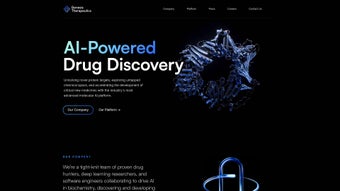

Download Genesis Therapeutics – AI‑Powered Drug Discovery Platform
Overview
Genesis Therapeutics has rapidly emerged as a benchmark in the rapidly evolving field of artificial‑intelligence‑driven drug discovery. By fusing advanced 3‑dimensional spatial‑graph modeling with high‑fidelity quantum‑level molecular simulations, the platform gives researchers the ability to explore chemical space that was previously inaccessible to conventional methods. The underlying engine converts every molecule into a graph that preserves its steric geometry, allowing the AI to reason about binding pockets, conformational flexibility, and even subtle electronic effects.
This depth of insight translates into higher‑quality hit identification, faster lead optimization, and a measurable reduction in costly late‑stage failures. Backed by a multidisciplinary team that includes veteran computational chemists, deep‑learning specialists, and full‑stack engineers, Genesis Therapeutics continuously learns from user‑generated experimental data, creating a virtuous cycle of model improvement. Strategic collaborations with industry leaders such as Eli Lilly, Roche, and Genentech provide real‑world validation, while a recent $200 million Series B round underscores strong market confidence.
Whether you are a biotech startup seeking a cost‑effective discovery engine or a large pharmaceutical company looking to augment an existing pipeline, Genesis offers a secure, scalable, and continuously updated environment that keeps you at the cutting edge of biomedical innovation. The platform’s cloud‑native architecture eliminates the need for on‑premises hardware, ensuring that teams can collaborate across continents without latency or compatibility concerns. In short, Genesis Therapeutics delivers a powerful combination of AI sophistication, regulatory‑ready reporting, and user‑friendly design that makes it an essential tool for modern drug discovery teams.
Key Features and Capabilities
The true strength of Genesis Therapeutics lies in its comprehensive feature set, which has been engineered to address every stage of the discovery workflow—from target de‑risking to final regulatory reporting. Each capability has been validated in peer‑reviewed studies and real‑world projects, ensuring that users receive both scientific rigor and practical usability. Below is a curated list of the platform’s most impactful functionalities, each supported by detailed documentation and example use‑cases.
- 3D Spatial‑Graph Modeling: Transforms molecular structures into graph representations that retain three‑dimensional geometry, enabling precise predictions of steric clashes, binding pocket compatibility, and conformational dynamics.
- Deep Molecular Simulations: Cloud‑native GPU clusters run quantum‑mechanics‑derived simulations in real time, delivering accurate binding affinity, solubility, and metabolic stability scores.
- Unexplored Chemical Space Explorer: An algorithmic engine proposes chemically novel scaffolds beyond traditional libraries, dramatically expanding the pool of viable candidates.
- Target De‑Risking Suite: Integrates AI‑predicted off‑target interactions, toxicity forecasts, and pathway analysis to prioritize safe, druggable proteins early in the discovery cycle.
- Collaborative Workspace: Secure, role‑based access with version control, annotation tools, and real‑time data sharing that comply with HIPAA and GDPR standards.
- Continuous Learning Loop: Experimental results fed back into the model refine predictions and reduce false‑positive rates with each iteration.
- API & SDK Integration: Fully documented RESTful APIs and Python SDKs allow seamless embedding of Genesis capabilities into existing LIMS, ELN, or custom bio‑informatics pipelines.
- Regulatory‑Ready Reporting: Automated generation of study reports, data provenance logs, and audit trails that satisfy FDA 21 CFR 11 and EMA guidelines.
- Adaptive Cloud Scaling: Compute resources automatically scale based on workload demand, ensuring optimal performance without manual intervention.
Installation, Setup, and First‑Run Workflow
Genesis Therapeutics is delivered as a cloud‑native SaaS solution, which eliminates the complexities of local installation and hardware provisioning. The onboarding process has been streamlined to allow even non‑technical users to launch a full discovery project in under thirty minutes. Follow these detailed steps to get up and running quickly:
- Create Your Account: Navigate to the official Genesis Therapeutics portal, click “Sign Up”, and provide a professional email address, organization name, and a brief description of your research focus. An automated verification link is sent instantly.
- Select a Subscription Plan: Choose between the free “Explorer” tier (limited compute credits) for proof‑of‑concept work, or the paid “Accelerator” tier (unlimited GPU hours, priority support) for larger projects. Academic institutions can request discounted enterprise licenses.
- Configure Your Workspace: After logging in, access the “Workspace” dashboard to create a new project, assign team members, and define data‑access permissions. The wizard guides you through naming conventions and metadata tagging to ensure reproducibility.
- Upload Molecular Data: Drag‑and‑drop SMILES strings, SDF files, or protein PDB structures into the “Data Library”. Genesis automatically validates file integrity and converts each entry into its internal 3D graph format.
- Run a Target Discovery Job: Select the “Target Explorer” module, specify disease area, and adjust search parameters such as binding pocket size and ligand flexibility. Initiate the job and monitor progress via the real‑time progress bar; results stream to your workspace as they become available.
- Analyze Results: Use built‑in visualizers to explore predicted binding poses, scoring distributions, and ADMET profiles. Flag promising candidates and launch a “Molecular Optimization” cycle that proposes analogs and predicts synthetic routes.
- Export Findings: Click “Export Report” to generate PDF, Excel, or JSON files. Each report includes full provenance metadata, model version, and confidence intervals—ideal for grant applications, internal reviews, or regulatory submissions.
- Close the Feedback Loop: Upload experimental validation data (e.g., IC₅₀ values). Genesis retrains its models on your proprietary data, continuously improving future predictions.
- Corporate Onboarding (Optional): For larger teams, request a “Corporate Onboarding” service that includes custom training sessions, migration of legacy data, and a dedicated success manager.
Because the platform runs entirely in the cloud, there is no need for OS‑specific drivers or additional hardware. Users can access Genesis from any modern browser on Windows, macOS, Linux, iOS, or Android devices, ensuring maximum flexibility for remote or hybrid work environments.
System Compatibility, Pros and Cons
Genesis Therapeutics is a pure web‑based application, which means it is compatible with any modern browser (Chrome, Edge, Firefox, Safari) on Windows 10/11, macOS 12+, major Linux distributions, as well as mobile browsers on iOS 14+ and Android 9+. No client‑side installation is required, and the platform automatically scales compute resources in the background, providing a consistent experience across devices.
Pros
- Zero‑install, cross‑platform access eliminates IT overhead and hardware constraints.
- State‑of‑the‑art AI models outperform traditional QSAR and docking methods, delivering higher hit rates.
- Robust security with end‑to‑end encryption, role‑based access, and compliance certifications (HIPAA, GDPR, ISO 27001).
- Highly extensible via RESTful APIs and Python SDK, enabling seamless integration with existing biotech pipelines.
- Active community, extensive documentation, and responsive support team ensure rapid problem resolution.
- Continuous quarterly model updates keep the platform aligned with the latest scientific data.
Cons
- Premium features (unlimited GPU, advanced analytics) require a paid subscription, which may be cost‑prohibitive for very early‑stage startups.
- Steep learning curve for non‑technical biologists unfamiliar with AI terminology and graph‑based representations.
- Dependence on reliable internet connectivity; offline work is not possible.
- Custom model training on proprietary data is restricted to the enterprise tier, limiting flexibility for smaller teams.
- Free tier offers limited compute credits, which may not be sufficient for large‑scale screening campaigns.
Conclusion and Frequently Asked Questions
In an era where the average cost of bringing a new drug to market exceeds $2 billion, accelerating the early discovery phase is no longer optional—it is essential for survival. Genesis Therapeutics delivers a compelling mix of AI‑driven insight, user‑friendly workflow, and enterprise‑grade security that positions it as a leading choice for both academic labs and pharmaceutical giants. Its cloud‑first architecture ensures that teams can collaborate across continents without the burden of hardware maintenance, while the continuous learning loop guarantees that the platform becomes smarter with each experiment you run.
Although the premium tier carries a price tag, the return on investment is evident through faster lead identification, reduced attrition rates, and the ability to explore truly novel chemical space. If you are ready to modernize your drug discovery pipeline, unlock previously inaccessible targets, and stay ahead of the competition, download Genesis Therapeutics today. Begin with the free Explorer tier to evaluate the platform’s capabilities, and scale to the Accelerator or Enterprise plans as your projects grow.
Is Genesis Therapeutics suitable for academic research?
Absolutely. The free “Explorer” tier provides enough compute credits for small‑scale projects, and discounted academic licenses are available for larger labs. All core features, including 3D modeling and molecular simulations, are accessible, enabling universities to compete with industry‑level tools.
How does Genesis ensure data privacy and regulatory compliance?
Data is encrypted both in transit (TLS 1.3) and at rest (AES‑256). Role‑based access controls restrict dataset visibility, and the platform complies with GDPR, HIPAA, ISO 27001, and FDA 21 CFR 11 standards. Detailed audit logs are generated for every action, supporting regulatory inspections.
Can Genesis be integrated with existing LIMS or ELN systems?
Yes. Genesis offers fully documented RESTful APIs and a Python SDK that can be called from most Laboratory Information Management Systems (LIMS) and Electronic Lab Notebooks (ELN). Sample libraries are provided for popular platforms such as LabWare, STARLIMS, and Benchling.
What kind of support is available for new users?
All new users receive a 30‑day onboarding program that includes video tutorials, live webinars, and a dedicated success manager for paid tiers. The free tier provides access to a community forum and knowledge base, while premium subscribers benefit from priority ticketing with a 4‑hour response SLA.
How frequently are the AI models updated?
Genesis releases model updates on a quarterly basis, incorporating the latest public datasets and internal validation results. Users are automatically migrated to the newest version, and a detailed changelog is provided for transparency.
Genesis Therapeutics impresses with its seamless integration of cutting‑edge AI and intuitive workflow. The 3D graph modeling dramatically improves hit‑to‑lead conversion, and the platform’s security features meet the strictest regulatory demands. While the learning curve for non‑technical users can be steep, the wealth of documentation and responsive support mitigate this hurdle. Overall, it’s a powerful addition to any drug discovery toolkit.